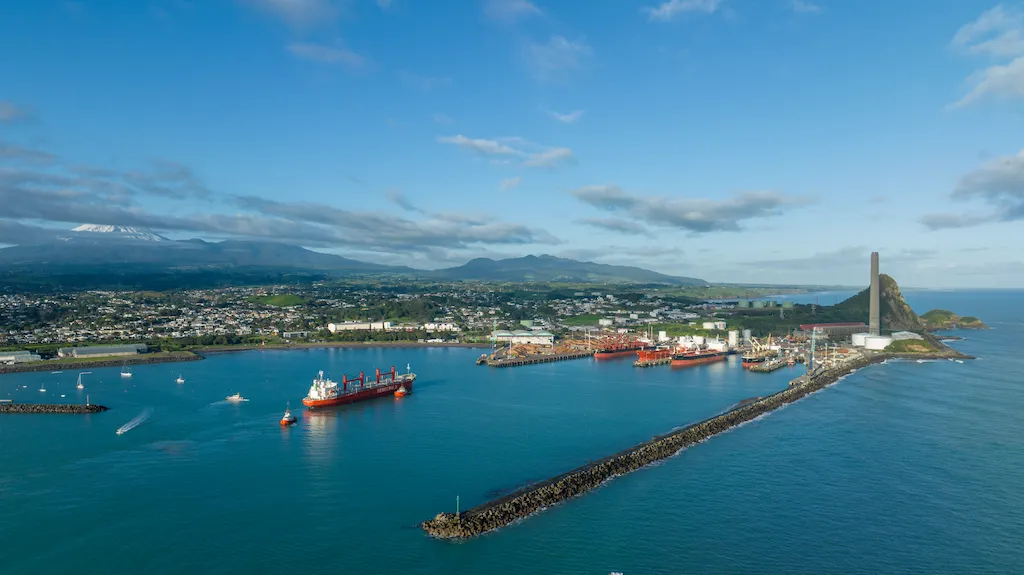
In February, the government announced it was moving ahead with a $1b liquified natural gas (LNG) terminal, shortlisting a handful of Taranaki locations for it. Nick Walker investigates the hotly debated cases for and against the project.
In 2006, a plan to build an LNG import terminal at Port Taranaki was launched as a joint venture between Contact Energy and Genesis Energy.
“Gasbridge” involved building a new terminal, large storage tanks, piping and integration infrastructure, all with the intention of ensuring New Zealand could generate enough electricity to get through a dry year.
Proponents cited declining production from local gas fields as a key reason why we needed to shore up our energy supply.
The project was scrapped after three years, with confidence in the availability of domestic gas, muted demand growth and rising costs all contributing factors.
Now, 17 years on, it’s back on the table. However, despite passionate opposition in some quarters, the government is adamant this time it’s going ahead – the only question is where.
The terminal
A fact sheet from the Ministry of Business, Innovation & Employment (MBIE) says LNG is natural gas that has been cooled and liquefied to make it easier to transport.
It is carried by ship to where it can be unloaded via pipe, stored, regasified and deployed into the transmission network for use.
Most LNG import facilities are ship-based, but there can be land-based components as well.
The intention for this project is to import LNG in large shipments only when it’s needed – for example, in a year where hydro and wind can’t generate the required amount of electricity to power the country. However, there are question marks over exactly when it could be triggered into action.
The price tag is north of $1 billion. The government says infrastructure costs will be paid for through a levy on electricity of between $2 and $4 per megawatt hour (MWh) – which would work out at around $30 per year for a household.
The government has shortlisted proposals, with all possible locations within Taranaki. Those locations haven’t been made public, though Port Taranaki chief executive Simon Craddock has said the port “was ready to be involved.”
The plan is to sign a contract by the middle of this year, with the facility to be operational by late 2027 or early 2028.
“A critical step”
The case for the LNG terminal is more or less the same as it’s always been.
Energy Minister Simon Watts says it’s “a critical step to strengthen New Zealand’s energy security and support economic growth.”
He says despite a renewable electricity boom in New Zealand, “a rapidly declining gas supply has left our electricity sector exposed during dry years, when our hydro lakes run low.”
Currently, in a dry year, gas- and coal-fired power stations ramp up to fill the gap in energy generation. In the industry, this is called firming.
Burning gas and coal means significantly more carbon emissions, and sends electricity prices skyrocketing because they cost more than renewables.
A good recent example is in 2024, when, according to the Electricity Authority, wholesale electricity prices increased from around $300/MWh to more than $800/MWh between July and early August as hydro lake levels plummeted to a six year low.
Another issue is, as a back-up, domestic gas supply is diminishing, so it can’t be relied upon into the distant future.
Watts said an LNG import facility would be a “reliable back up” that would reduce price spikes, ultimately cutting future prices by at least $10/MWh, outweighing that consumer levy and saving New Zealanders around $265 million per year, or $50 per household.
He says an LNG terminal is not intended to be a silver bullet, but one of a number of changes the government hopes will address energy affordability.
How did we get here?
Rising power prices have been on the government’s fix-it agenda for some time.
In 2024, Prime Minister Christopher Luxon said New Zealand was in an “energy security crisis”, with a need for “abundant affordable energy”.
He announced an independent review of the energy sector at the time, which came back opposing the case for an LNG terminal. It essentially said it was an exorbitant price tag for what would only be an energy back-up.
“It would make no economic sense to develop an LNG import terminal to meet just dry year risk as the large fixed costs would be spread over a relatively small amount of output,” the report said.
The government rejected a number of recommendations within that report; at the time, Watts said a procurement process for an LNG import terminal would begin the following week, with the aim of being delivered in time for winter 2027.
Separately, several gas and energy companies commissioned their own report into the viability of a large LNG facility.
That report was made public last year, and found that the costs of an import terminal would be too high for the industry to swallow without government support.
Support
When the LNG terminal was announced, electricity companies were quick out of the blocks to support it.
Contact Energy CEO Mike Fuge told Newstalk ZB an LNG import terminal was “sensible”, and that it would remove the drama of the current system.
“When suppliers and gas users can’t get gas, everyone gets very uptight, and this brings a rationality to the market, so we aren’t worrying about tomorrow.”
Port Taranaki’s Simon Craddock said it would be a “fillip” for Taranaki, which has “weathered several challenging years” through the decline in oil and gas activity. He sees the opportunity for local employment, as well as supporting the energy transition.
“As gas reserves decline, LNG imports shape as an important part of the overall energy solution for New Zealand. The availability of LNG fuel for firming will ultimately support the build-out of more renewable generation projects, allowing the time for these projects to progress,” he said.
“We’re aiming to develop a multiuse facility here that can support a range of energy solutions, including renewable projects, such as the Kapuni renewable energy and green hydrogen project and, eventually, an offshore wind industry in Taranaki.”
Opposition
According to Radio New Zealand, the response to February’s announcement from “almost every corner – other than the gas industry itself – was a collective groan”.
There are many critics of the project from many different backgrounds. Opposition is based on a range of factors, including the high cost of LNG, concerns it extends our reliance on volatile imported fuels, and a sense that there are cheaper, cleaner alternatives.
While an LNG import terminal would boost energy security by creating a back up source of energy, it wouldn’t alleviate power prices in non-dry years. Those prices have already proven too high for some operators, including the likes of the Winstone Pulp Mill, which cited unsustainable wholesale power prices when closing its New Zealand operation in 2024. (This point was strongly contested by its supplier, Mercury).
In a time where there is a push towards building renewable projects and progressing the energy transition, critics say LNG is a step in the wrong direction.
There are also concerns around safety, the impact on neighbours, and, in the event the terminal is built at Port Taranaki, what it could mean for the likes of Ngāmotu Beach.
The government’s numbers have also been heavily scrutinised, with the New Zealand Green Building Council saying the $50 household savings estimate doesn’t consider how energy prices rise when countries become more dependent on global gas markets.
Another key issue opponents point out is that every dollar invested in an LNG facility is a dollar that could otherwise be spent on an alternative that isn’t based on a high emitting, imported fossil fuel.
It’s not clear whether the project relies on National winning the election in November. Labour leader Chris Hipkins said in February that if he was in government before a deal is done, he wouldn’t go through with it.
As mentioned previously, the government plans to sign a contract well ahead of that time.
Energy (in)security in action
To nobody’s delight, the case for enhancing our energy security has been made clear in recent weeks.
Iran’s closure of shipping routes through the Strait of Hormuz, where approximately 20% of the world’s total oil freight travels, has seen prices spike and concerns raised about how much supply countries have in reserve.
It’s also a critical passage for the world’s LNG. Qatar, which supplies a reported 20% of global LNG exports, has suspended production, sending prices soaring by upward of 50% (and counting) in some markets.
Previously, the Russian invasion of Ukraine saw LNG prices double in 12 months. These examples illustrate how the price and supply of LNG is highly volatile, particularly when it comes to geopolitical pressures.
So while LNG may provide an alternative supply of energy in dry years, there’s no knowing what price we might have to pay for it.
If not LNG, then what?
The government modeled four other options in its assessment and approval of an LNG import terminal:
- New coal or biomass power plants
- New and converted diesel-powered peakers
- A combination of peakers, a new Huntly coal unit and demand response
- LNG imports plus refurbishment of the Taranaki Combined Cycle gas plant in Stratford, which is currently being decommissioned
Electrification advocate Rewiring Aotearoa says its preferred alternative is to have much more solar assets on home, farms and businesses to keep water in our hydro lakes, together with more wind and geothermal projects to reduce the reliance on fossil fuel-powered energy generation.
Analysts of the LNG decision have pointed out a seeming lack of investigation for other renewable projects to address the dry-year shortfall.
Taranaki-based hydrogen company Hiringa Energy and its partners are currently constructing various projects that promise both price and supply stability, including one here in Taranaki that’s being built in partnership with MBIE.
The Kapuni Project involves construction of four wind turbines and a green hydrogen production facility at the Ballance Agri-Nutrients Kapuni plant, generating enough renewable electricity to power around 24,000 homes and reducing our reliance on imported diesel and fertiliser. Other partners are Todd and Parininihi ki Waitotara.
As well as its decarbonisation benefits for the transport, energy, industry and agriculture sectors, it purports to enhance New Zealand’s energy security profile by establishing a sovereign source of clean energy that reduces our reliance on imported fuels and fertilisers.
Hiringa has also built and is operating New Zealand’s only green hydrogen refuelling network for hydrogen trucks. Another project, dubbed Harakeke, is a pioneering wind and green hydrogen facility near Whanganui that will produce a domestic supply of marine fuel from wind, water and forestry waste.
These projects aren’t developed specifically for that dry year scenario, but all involve domestic energy production and product manufacturing that would only help.
For example, the supply and price of the electricity and green hydrogen the projects do, or would, generate would be unaffected by global market volatility, the likes of which we’re experiencing today.
Stepping back, one of the central issues is whether renewable energy projects are capable of serving as an affordable, effective backup to cover our dry-year needs.
Supporters of an LNG terminal appear to say no. They don’t necessarily dislike renewable energy; they just don’t think it’s ready – yet.
Opponents inevitably disagree. They also point out that renewables could develop considerably with the benefit of the $1b of funding that’s being put towards LNG.
It seems an LNG terminal will never have unanimous support, but it likely doesn’t need it.
With the government determined to see it through, an announcement on the contract in the coming months is likely the next step along the road to delivering this legacy energy infrastructure, like it or not.