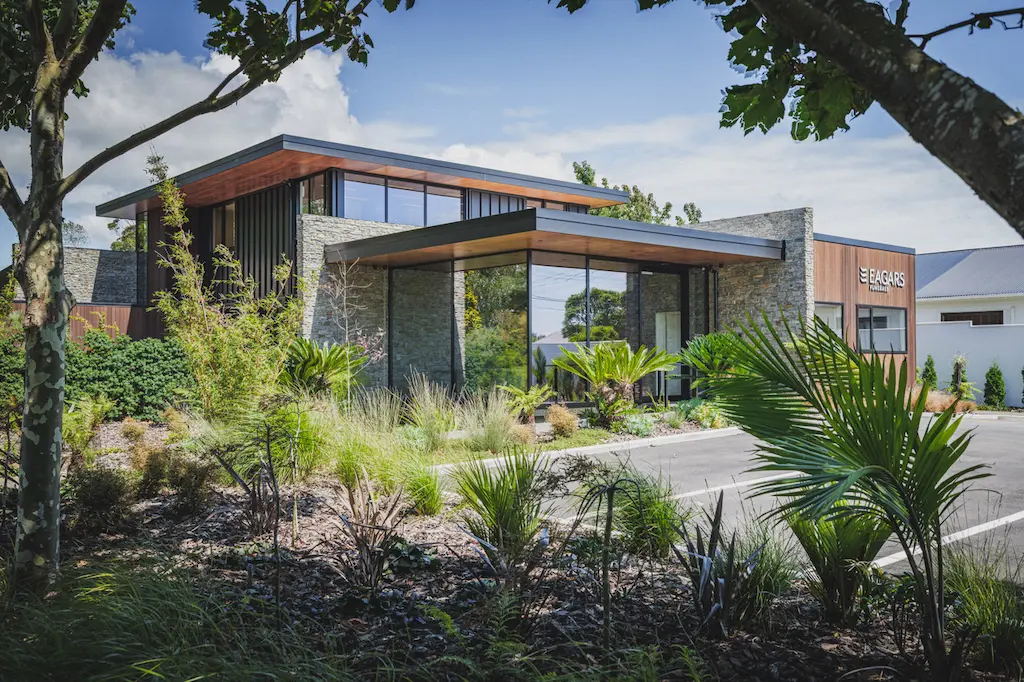
Over the past few years, a once undeveloped corner of the Te Henui cemetery has been reimagined into a space that both capitalises on its natural beauty and elevates the experience it offers to the community.
The latest upgrade of the Eagars Funerals site at the cemetery entrance on the corner of Watson and Lemon Streets has been driven by a goal of enabling families to gather, grieve and remember in ways that feel personal and uplifting.
“This is the embodiment of what we believe makes for a good funeral,” says general manager Richard Martin.
“It’s been driven by the whole notion of a positive funeral experience, through our chapel, our offices and reception and the high level of care in our funeral home.”
The transformation has effectively doubled the footprint of the original funeral home, taking it from 160 square metres to around 335 square metres. The front cottage has been replaced by a new reception area, viewing and family rooms, extra office space for staff, and a work room for printing and digital services.
“Previously we could only host one family at a time, but now we’ve got capacity to have effectively three different groups of people in their own spaces,” Richard says.
“As much as possible when we’re looking after a family, we want them to feel they’re the only family we’re looking after, and this gives us that capacity.”
Designed for community
The new building has been carefully designed to complement the Te Henui Chapel and sit comfortably among the established trees and gardens. From the street, the new building feels as though it has always belonged.
“Transformation is probably an understatement,” Richard says. “Ten years ago, this was a council parks depot that hadn’t had much attention. Now it’s a place that feels appropriate for what people are going through in the context of organising and hosting a funeral.”
New spaces offer greater options and flexibility for families.
A small nature area opens to a deck and landscaped gardens that can host intimate services of up to 25 people. At the other end of the scale, Te Henui Chapel accommodates up to 400 guests.
Richard says his favourite part of the new build hits you as soon as you walk in the front door.
“Our reception has an overhang over one of the new ponds. It’s surrounded by glass, so the morning light bounces off the pond and reflects on our Meranti plywood ceiling and schist walls. It has the effect of making the reception really shimmer – a lot of people have commented on that already.”
The extra staff spaces were designed to support the broader Eagar’s team. It’s an acknowledgement that staff can work long, odd hours, and they need to be at their best in order to support families making funeral arrangements.
“We want our staff to feel proud of where they work and be as comfortable as possible while they’re here. The physical space supports our people to deliver the best possible experience,” Richard says.
Excellence in practice
The new facility reflects the Eagar’s philosophy; “When death occurs in your family, you will be cared for by ours.”
For Richard, it’s about retaining a family feel in the way they look after people when they’re bereaved.
“You only lose someone once. Every aspect of that experience needs to be the very best it can be. Vehicles clean, staff well presented, communication clear and concise. Every touch point that we have with a family, we show that we care super deeply about what we do.”
He says the key is in the details, and often that means picking up on little things that can make a funeral extra special.
Recently, a family mentioned their loved one had farmed in Mohakatino. Without being asked, staff sourced an image from the area and displayed it on the large tv screen for people entering the chapel.
“When they arrived they said, ‘That was our farm.’ It was a small thing, but it showed we were listening,” he says.
In another case, a family wanted to begin a service with a recording of The Country radio show that their dad used to love listening to. Instead, Eagars contacted host Jamie Mackay, who recorded a personal welcome for guests as they arrived at the funeral.
“You can’t always do those kinds of things, but our team is really good at identifying opportunities and delivering on them respectfully and appropriately so families come away with memories they carry for the rest of their lives.”
Partners in excellence
Throughout the build, key partners helped bring the vision to life.
VOID, led by architect Scott Ferguson, also designed the recent chapel upgrade, and have worked with Eagars for nearly a decade.
“Having someone who deeply understands what you’re trying to achieve makes a huge difference,” Richard says.
“Livingstone Building was the lead contractor. They had a really compelling presentation and a commitment to health and safety. The level of detail in the work programme was exceptional and you can see that in the finish is exceptional.”
The gardens, created by Mike Mansvelt of Jungle Nursery, are the sixth or seventh collaboration between the businesses.
“We trust Mike,” Richard says. “We give him a budget and say, ‘Make it look good.’ This is one of the few public gardens he’s done, and it’s a showpiece.”
The value of ritual
Richard believes funerals matter deeply. While they’re fundamentally sad at their core, he says most funerals are able to be an uplifting experience for families and guests.
“90% of funerals are for people who’ve lived a life, and that’s the bit you celebrate and acknowledge and reflect on. It can create an experience that becomes a touchstone for your relationship with that person.”
A good funeral, he says, steps outside everyday life.
“Ritual and ceremony are important. Music, readings, prayers, lighting candles. The right mix, appropriate to the person.”
That mix is perhaps at the heart of what Richard says is a bit of a shift in modern funerals. They’re no longer dour or uninteresting, and can be customised in so many different ways.
“We often hear families say, ‘So-and-so always said they didn’t want a fuss. Then they came to a funeral here, went home and said, ‘If that’s what a funeral looks like these days, you can do that.’
“You only get one chance to get a funeral right, but it can mean so much when you do.”